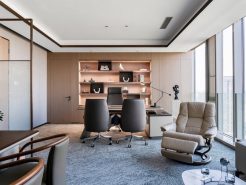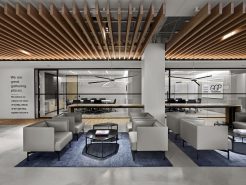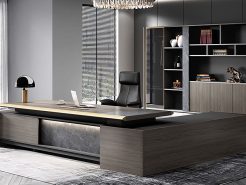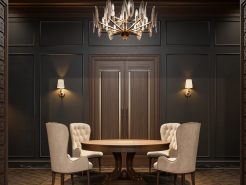

In the chairman’s meeting room, people often discuss lighting, wood materials, or the price of the furniture. But few realize that the most powerful element lies in its shape. A rectangular table can silence the entire room before a meeting begins. A rounded table can even soften the biggest egos. No declarations, no emphatic titles are needed. It is the straight lines or curves that draw the invisible map of power. And sometimes, just one wrong choice of shape is enough to change how others perceive the leader.
1. The psychological foundation of geometric shapes in the chairman’s meeting room
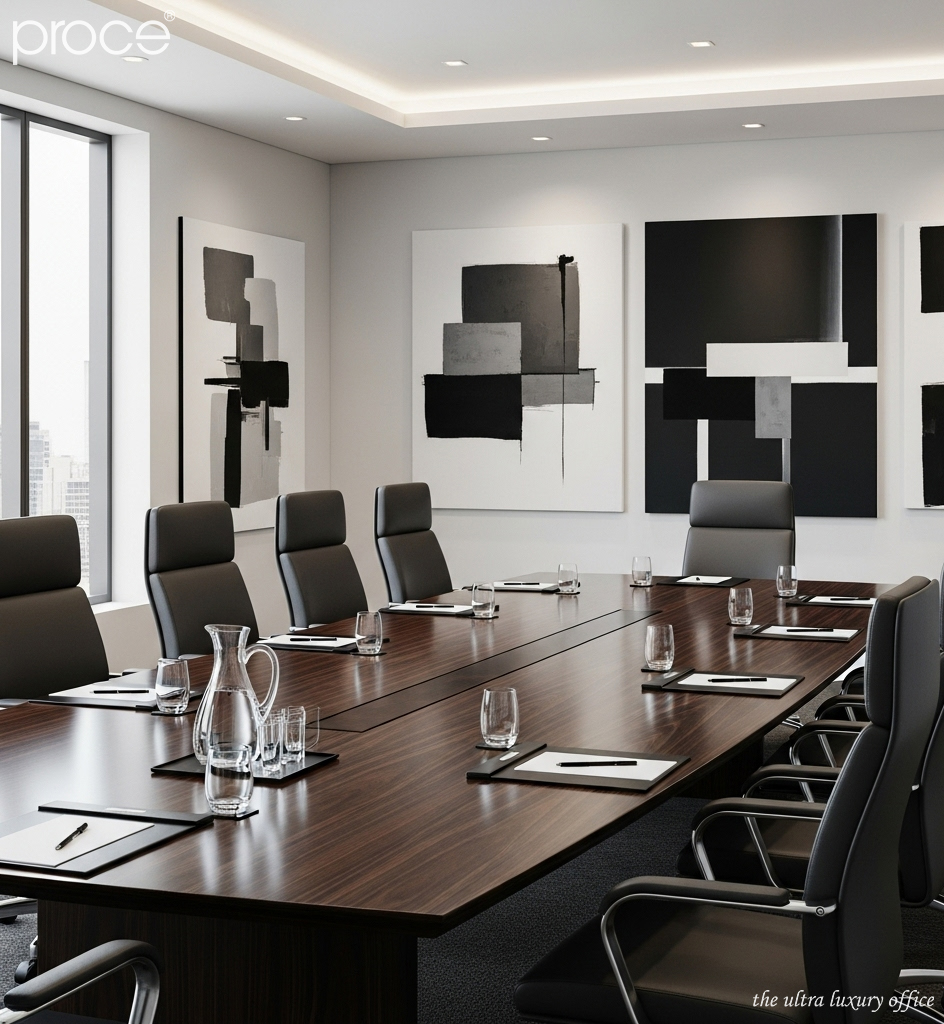
Rectangle – A symbol of structure and power
In spatial cognitive psychology, rectangles represent stability, control, and deliberate structure. The human brain processes straight lines and right angles as signals of conscious intervention—that is, products of thinking, planning, and power. Unlike curves, which evoke associations with nature, straight lines rarely appear perfectly in the natural environment. Therefore, when they appear in space, they are interpreted as signs of control and order.
Straight edges create clear boundaries, helping to define space, position, and role. In the context of a chairman’s meeting room, a rectangular layout reinforces the hierarchical structure. The head of the table is often the default position of highest authority. This is not only symbolic but also directly impacts behavior. The person seated in the center of the head of the table tends to receive more attention, experience fewer interruptions, and is implicitly recognized as having the authority to coordinate.
Emotionally, rectangular shapes evoke a sense of stability and security due to their balance and predictability. They minimize ambiguity, increase discipline, and promote goal orientation. In high-level leadership spaces, rectangles are not merely an aesthetic choice; they are a statement of power structure, managerial competence, and strategic control.
Circle/Oval – Symbol of connection and equality
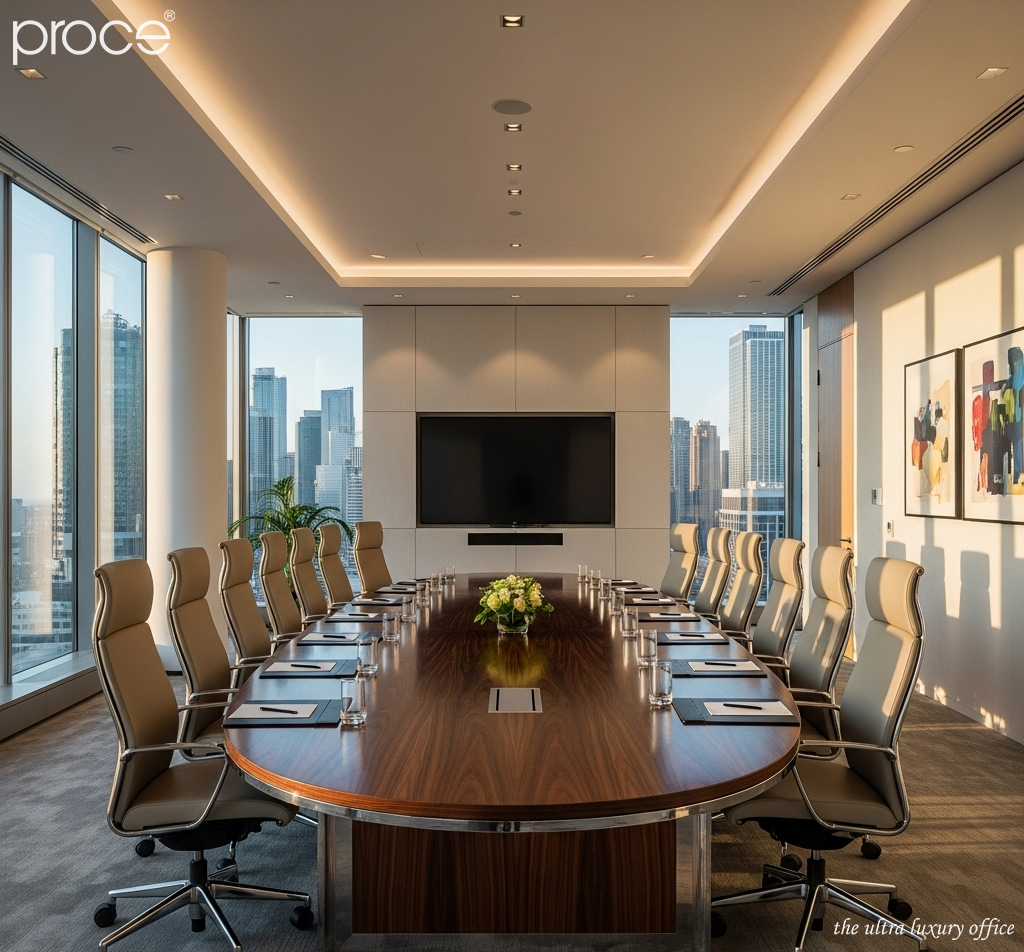
From an evolutionary psychology perspective, the human brain responds more positively to curves than to sharp angles. Perceptual studies show that curves are processed as signals of “safety,” while sharp angles can trigger a subconscious wary response. Circles and ovals therefore create a less threatening environment, encouraging openness and interaction.
With no beginning or end point, the circle eliminates the concept of “head of the table.” In a meeting room layout, this reduces the perception of clear hierarchy, instead fostering a sense of equal standing. Members can more easily make eye contact with each other. This enhances multi-directional dialogue and limits the “one-way presentation” mentality often seen in linear structures.
From an organizational sociological perspective, round tables are often associated with a collaborative leadership model, where the leader acts as a facilitator rather than an authoritarian one. The oval space also helps maintain formality while remaining softer than a perfect circle, creating a balance between authority and tolerance.
In the chairman’s meeting room, using a circular or oval shape does not undermine the leadership’s position. On the contrary, it reflects a modern leadership style that is confident, controlled, yet willing to listen. This choice fosters a culture of strategic dialogue rather than simply asserting a power structure.
2. The spatial psychology of rectangular tables in the chairman’s meeting room
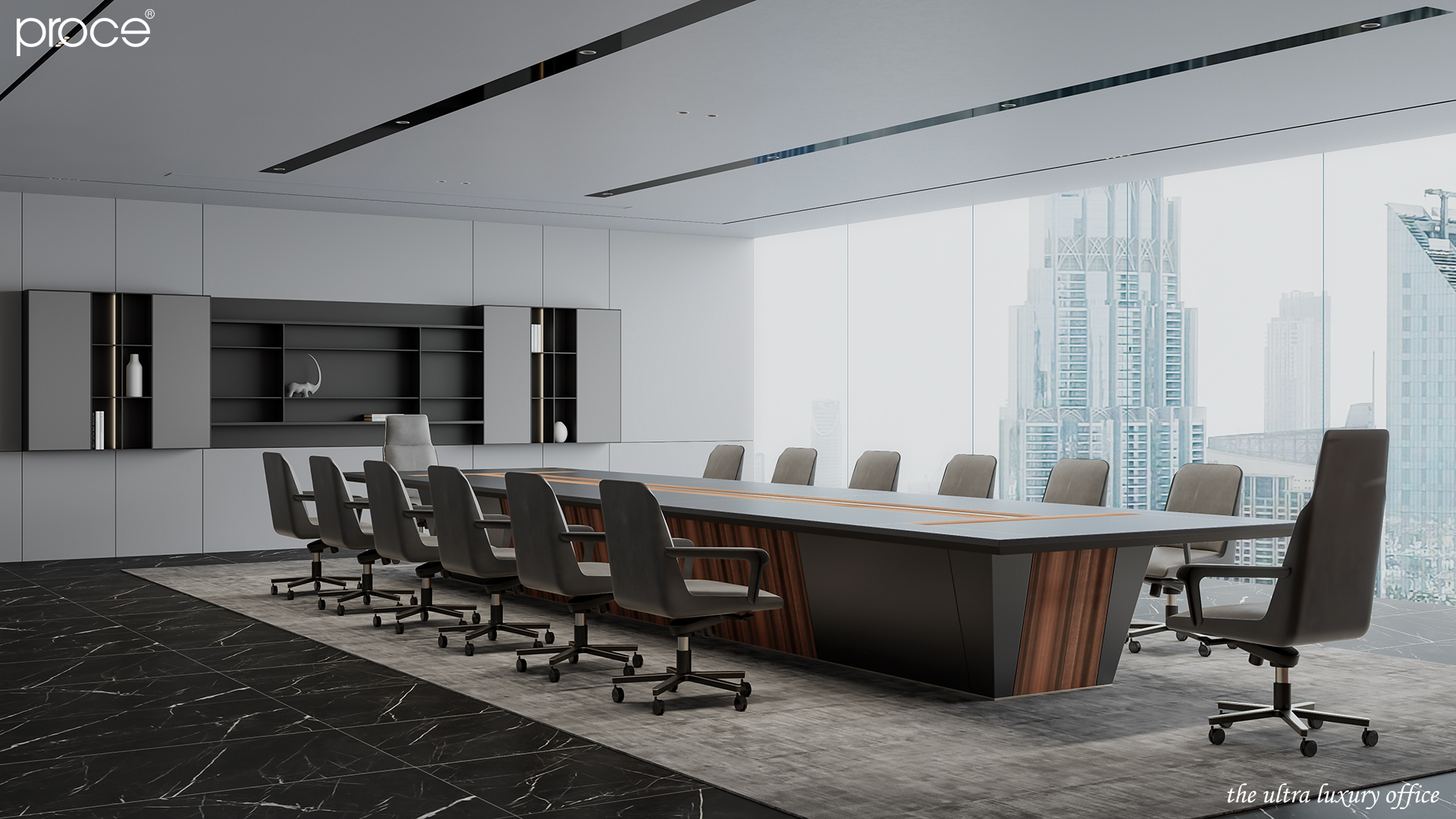
In environmental psychology, form is not just an aesthetic element. It is also a tool for shaping behavior and power structures. The rectangular table in the chairman’s meeting room is a highly symbolic structure. It establishes order, hierarchy, and control from the very first moment one enters the space.
Straight edges and right angles subtly convey a message of order, discipline, and clear boundaries. Unlike the inclusive circular shape, a rectangular desk creates an “axis of power,” where the head of the desk naturally becomes the central coordinating position. The human brain tends to interpret this position as the highest point in the hierarchy, thereby reinforcing an undisputed leadership role.
This arrangement forms a clear “power map” in the subconscious
The person seated at the head of the table holds the decision-making role, while the person opposite is often perceived as a counter-argument or a balancing act. The two sides are areas for support, reporting, or execution. This arrangement is not merely symbolic; it directly influences speaking behavior, interaction frequency, and presentation confidence. Communication tends to be vertically focused, from members toward the chair, rather than spreading horizontally among individuals. This is particularly relevant in meetings involving approvals, strategic decision-making, tense negotiations, or high-level client meetings, where projecting authority and controlling the pace are crucial.
The risks of choosing the wrong desk for a chairman’s meeting room
However, this very structural clarity also has a downside. Square spaces can easily increase psychological pressure, especially on lower-level staff. The physical and symbolic distance between the head of the desk and the rest of the workstations can reduce initiative in speaking and limit creative exchange.
In the context of traditional businesses, large corporations, or restructuring phases requiring tight control, a rectangular table is a sound strategic choice. However, if the culture leans towards openness, flexibility, and co-creation, a rectangular table can inadvertently reinforce leadership and team divisions. Therefore, choosing the shape of the meeting table is not just a design decision; it’s a statement about the leadership style and power structure the chairman wants to establish within the organization.
>> See more: How long does a chairman’s meeting room project at Proce take?
3. Leadership strategies hidden in the design of rounded/oval tables in the chairman’s meeting room

Before anyone speaks, the shape of the table sends a message about how power will be exercised in that room. Rounded or oval tables create a spatial configuration where power is no longer concentrated at a single point, but rather distributed outwardly. Completely removing the “head of the table” diminishes the signal of rigid hierarchy, instead establishing a more perceptibly balanced interactive environment. In perceptual psychology, curves are treated as softer and less threatening than sharp angles. Therefore, spaces using rounded edges tend to reduce psychological defenses and increase feelings of safety when speaking.
The oval structure also optimizes eye contact, a core element in building trust and persuasion. Members can easily observe each other’s reactions without excessive body movement, naturally fostering peer exchange. This reduces the tendency for “speaking up to superiors” and enhances substantive group discussion. The chairperson’s role in this context shifts from a central control position to a strategic coordinator, setting the pace, synthesizing opinions, and drawing conclusions, rather than dominating through physical position.
When should you choose a round table?
The round-table model is particularly effective in strategic meetings, innovation sessions, digital transformation meetings, or long-term vision building, where collective intelligence is a core asset. It is well-suited to organizations that prioritize empowerment, encourage constructive criticism, and seek to attract young talent who thrive in an open environment.
However, in situations requiring a clear display of authority, such as tense negotiations or hosting traditional partners, the lack of a “power anchor” can diminish prestige. Therefore, a rounded table is not just a design choice; it’s a statement of leadership style: power is reinforced by influence and connection, rather than by a dominant position.
>> See more: E0 and E1 standards for materials in the chairman’s meeting room.
Conclude
Ultimately, the deciding factor isn’t whether a rectangular or round table is more aesthetically pleasing. It’s the message you want to send in the chairman’s meeting room. Every straight line is a statement of control and order. Every curve is an invitation to connection and collaboration. That space will reflect your leadership style even before you speak. Therefore, choosing the shape isn’t just about interior design; it’s about how you want to be perceived. An authoritative commander or a leader who listens and inspires? And sometimes, the future of a business begins with that silent choice.
=====\
PROCE – TOTAL LUXURY OFFICE SOLUTION
Website: https://proce.vn/
Youtube: https://www.youtube.com/@noithatvanphonghangsang
Fanpage: https://www.facebook.com/vanphongnhapkhauProce
GG Business: https://business.google.com/dashboard/l/15115233216900975876
Linkedin: https://www.linkedin.com/company/74359718/admin/
Hotline: 090.115.6767
#phong_hop_phong_chu_tich; #Phong_hop; #phong_hop_phong_chu_tich_chuan_sang
#thiet_ke_phong_hop_phong_chu_tich; #noi_that_phong_hop_phong_chu_tich
# derco_phong_hop_phong_chu_tich; #phong_hop_phong_chu_tich_dep