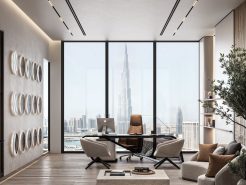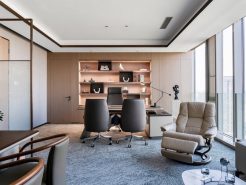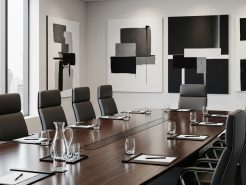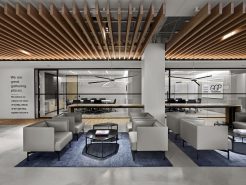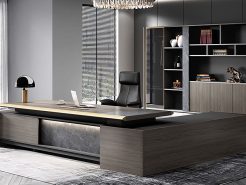

In designing the chairman office, the question “how much space is enough?”. Seems simple, but it’s a strategic problem many businesses misunderstand. Based on my experience directly advising on and implementing high-level executive spaces, I’ve realized that the size of a chairman’s office shouldn’t be decided by emotion, ostentation, or hearsay. A room that’s too small will diminish prestige, but a room that’s too large can easily backfire if the design isn’t carefully controlled. The core issue lies in the balance between space, the leadership role, and the corporate culture. This article will delve deeper to determine the appropriate, standard, and long-term value for the size of the office.
1. Chairman’s office area – There is no fixed number, only a “suitable standard”
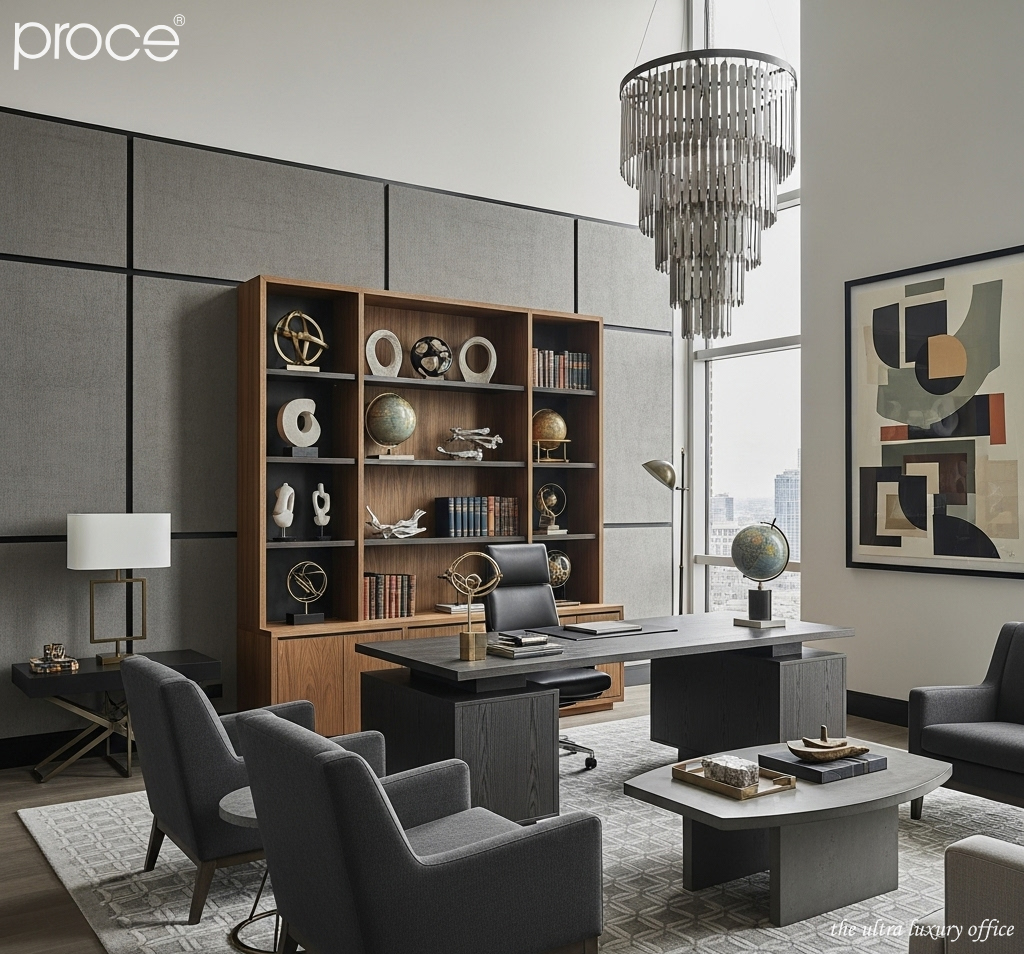
When discussing the size of the chairman’s office, I often share with clients that there is no single standard size that applies to every business. The essence of this space lies not in square meters, but in its suitability. The chairman’s office is a place where many layers of value converge, from leadership authority and strategic thinking to operational rhythm and corporate culture. Therefore, the size must be determined by several parallel factors. First and foremost is the scale of the business; a large organization with a complex management system, numerous executive levels, and high-level partners inevitably requires a commensurate space for receiving, working with, and making decisions.
The actual role of the chairman
If you’re frequently involved in management, the office space needs to accommodate quick meetings, team discussions, and continuous workflow. If you’re more focused on strategic planning, the space needs to be quiet, have depth, and a sense of overall control. Company culture is also a key factor, as some organizations prioritize intimacy and minimalism, while others value standards, discipline, and leadership image.
Ultimately, the frequency of client visits and internal meetings will determine whether the chairman’s office is merely a personal workspace or a “high-level communication center.” Therefore, a chairman’s office should not be judged by its size, but rather by whether it is appropriate in stature, role, and effectively serves the highest leadership position.
>> See more: President’s office interior – Top wood tones that “highlight success”.
2. Designing the Chairman Office – Area benchmarks based on the scale of each enterprise
The chairman office, 25–30m² in size – Compact and focused
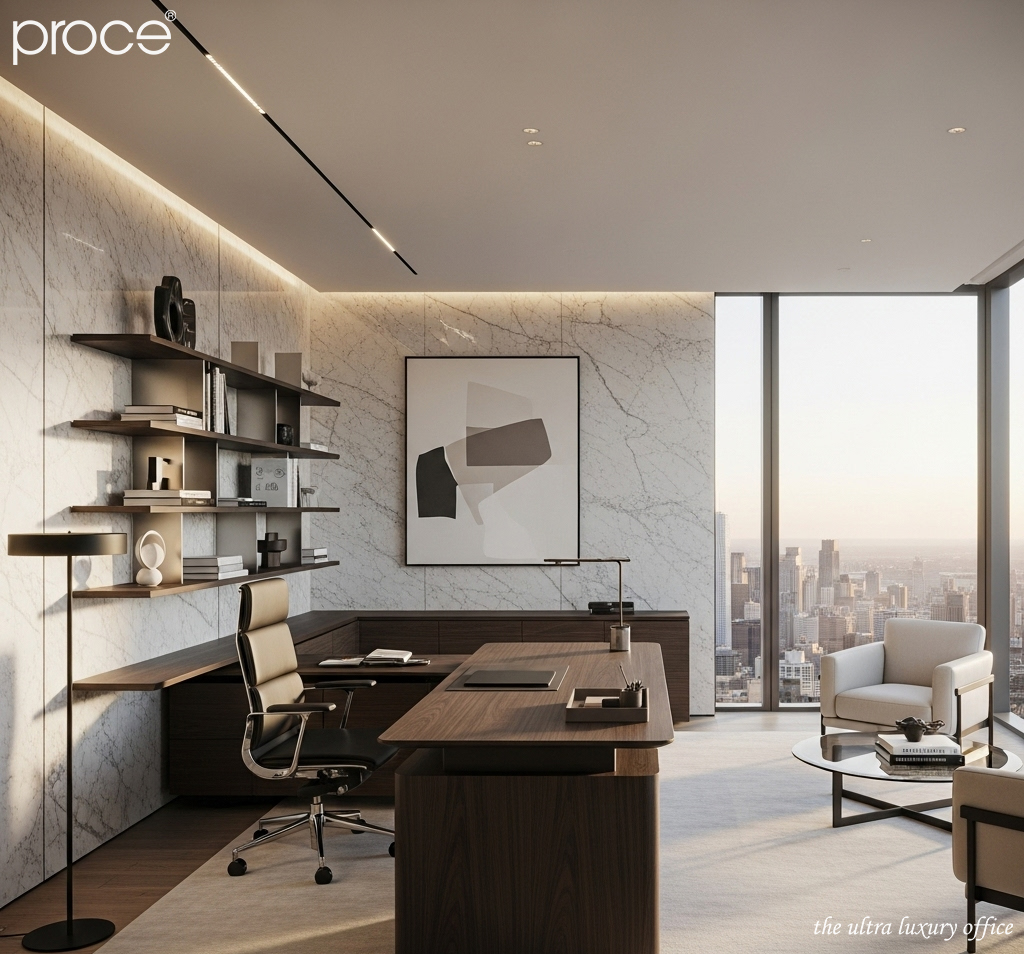
With a chairman’s office size of approximately 25–30m², this is a compact yet focused option. It’s suitable for businesses that prioritize operational efficiency over ostentation. During consultations, I often see this size in small and medium-sized enterprises, startups, or family businesses, where the chairman often also serves as the CEO and is directly involved in daily operations. In such cases, the office is not only a decision-making space but also a high-intensity personal work area.
In terms of design, the focus of the space should be on the workspace
This is a factor that helps ensure focus, privacy, and convenience for continuous use. In addition, the room can still accommodate a small sofa for 2-3 people, sufficient for quick discussions, short work sessions, or internal meetings. However, with limited space, layout and organization play a crucial role. Choosing minimalist furniture, appropriate proportions, and combining lighting and colors effectively will prevent the space from feeling heavy or cramped.
From a professional standpoint, I consider 25–30m² to be an acceptable size. It can even be efficient if designed intelligently and purposefully. However, this space would be unsuitable for a chairman who frequently entertains high-ranking guests or holds diplomatic meetings. In such cases, the limitations of the space would quickly become apparent.
Designing the chairman office with an area of 35–45m² – The most common and safest standard
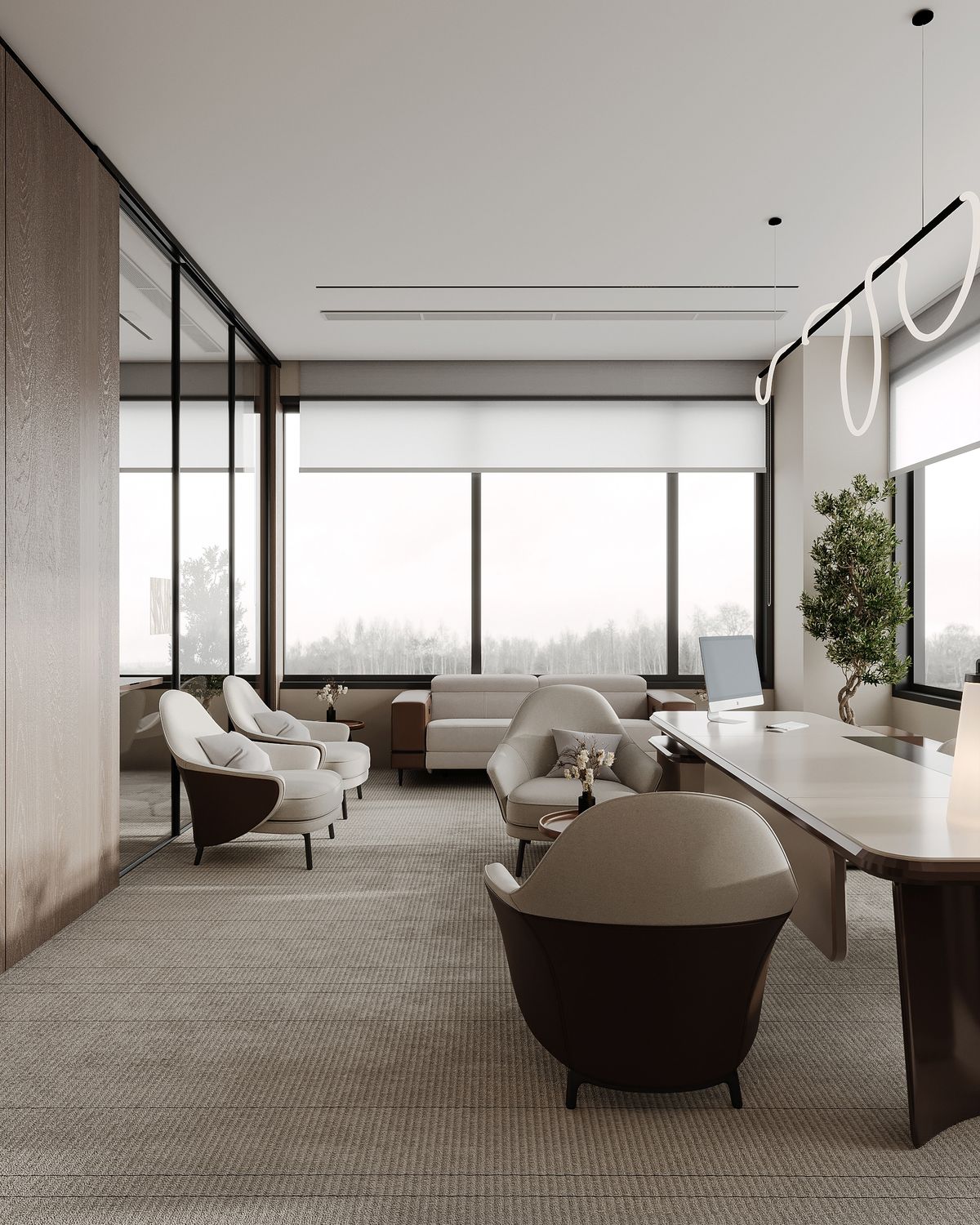
Through working with various business models, I’ve found that a chairman’s office with an area of 35–45m² is often chosen as the most balanced and effective solution for senior leadership space. This size is particularly suitable for medium-sized businesses, joint-stock companies, or small corporations, where the chairman plays a central role in management, strategic direction, and external relations. The space not only serves personal work but also represents the “face” of the business when receiving important partners.
In terms of floor plan organization, 35–45m² allows for the construction of a clear and rational spatial structure
The main workspace is centrally located, reflecting focus and control. Alongside it is a separate reception area, typically furnished with sofas seating 4-6 people. This provides sufficient formality for strategic discussions or external meetings. Furthermore, this space is flexible enough to integrate file storage, bookshelves, or a display area for achievements. This ensures the office space has both personal depth and reflects the company’s growth and development.
From a professional perspective, this is considered the “standard” size because it strikes a balance between the image of leadership and practical use. It’s not too large to be wasteful, but spacious enough to create a sense of luxury, balance, and authority. In fact, about 80% of the executive office projects I’ve designed fall within this size range. This demonstrates that it’s a safe and sustainable choice for many business models.
Designing the chairman office with an area of 50–70m² – A space for senior leaders and large corporations
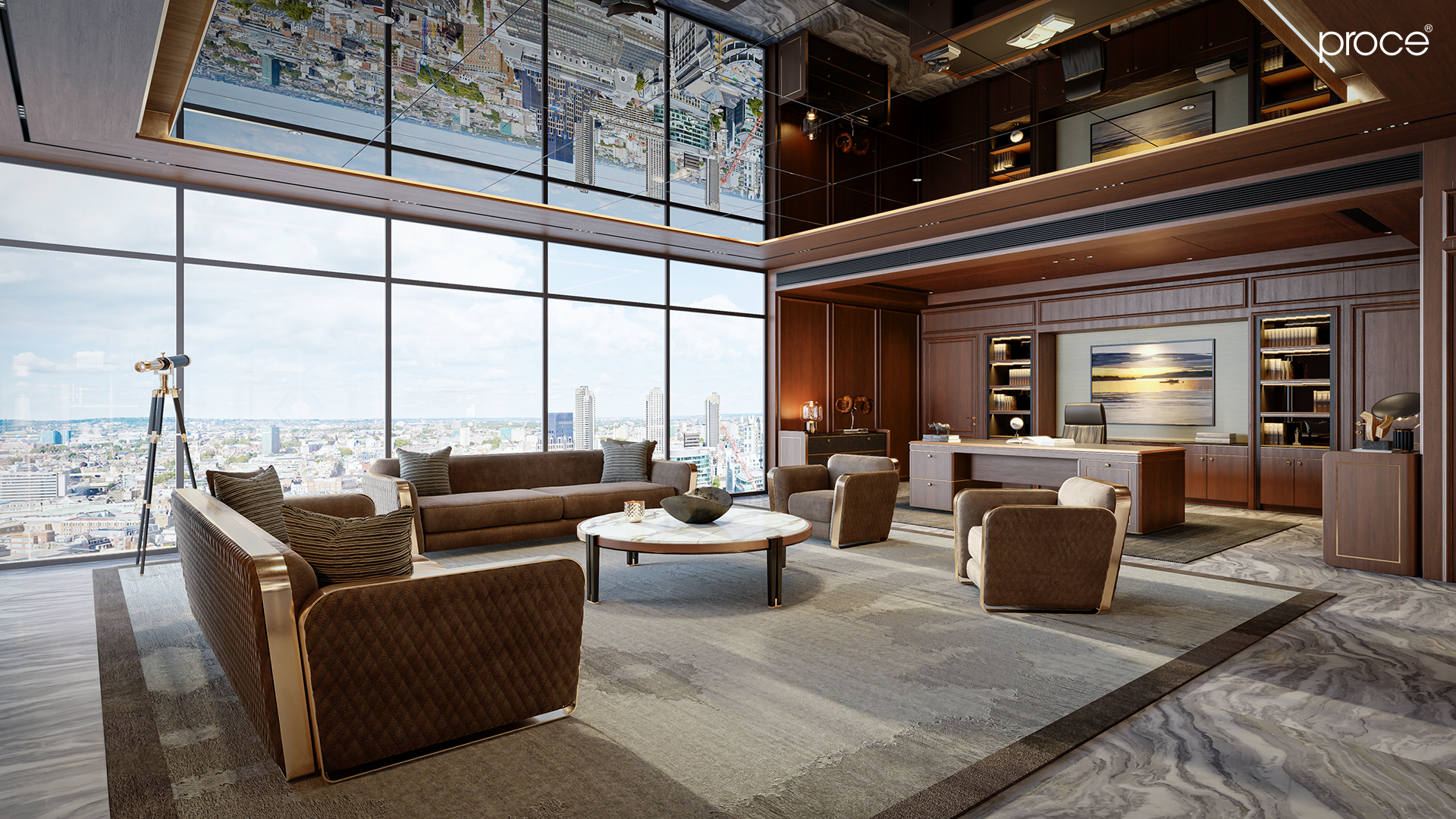
When the size of the chairman’s office is expanded to 50–70m², we are entering the category of spaces reserved for senior leaders of large corporations and conglomerates. At this level, the office is no longer simply a place for handling personal work. Instead, it has become a space representing the power, strategic vision, and external capabilities of the business. This size is particularly suitable for chairmen who focus on strategic planning, receiving high-level partners, and participating in important external activities. Each meeting here carries significant meaning in terms of image and status.
Structurally, a chairman’s office of 50–70m² is usually organized according to a clearly defined partitioning model
The workspace is arranged independently, ensuring complete privacy and focus. Separate from it is a large reception area, formal enough to welcome strategic partners or high-level delegations. Additionally, this space allows for the integration of smaller meeting tables for 6-8 people, facilitating quick strategic discussions, as well as a relaxation area or a symbolic display area showcasing the company’s philosophy and development journey.
The biggest advantage of this size is its ability to clearly showcase leadership stature and create a “leadership-class” experience for partners from the very first contact. However, from an expert’s perspective, I always note that if the design is not well controlled, a large space can easily become empty, sprawling, and lacking in focal points. In that case, the large area is no longer an advantage, but becomes a challenge in creating depth and emotion within the space.
The chairman’s office, over 80m² – A space of class and power

With a chairman’s office exceeding 80m², I always consider this a special choice. It should only be applied in truly appropriate contexts. This space represents the pinnacle of prestige and leadership power. In reality, this model is only suitable for multinational corporations and very large businesses. Where the chairman not only holds a managerial role but also engages in diplomacy, receiving international partners and chairing high-level strategic meetings. In such cases, the office is no longer a mere personal space but becomes a miniature center of power, where important decisions are made.
In terms of functionality, a chairman’s office over 80m² typically serves multiple purposes within a single space
In addition to separate work areas, the office also integrates a large reception area and a strategic meeting room. It’s formal enough for long-term strategic meetings. Each area needs to be meticulously organized, with a unified design language, to create a sense of authority, control, and centralized power.
However, from an expert’s perspective, I always emphasize that the larger the area, the higher the risk of misuse. An overly large space easily loses its necessary warmth and dilutes the sense of centralized power. Furthermore, investment and operating costs increase significantly, requiring careful planning. In particular, a design lacking depth or a sprawling layout can be visually counterproductive, making the space feel cold, ostentatious, and distant—completely contrary to the spirit of a truly classy executive office.
>> See more: Designing a chairman’s office is not for companies that can rush the process and offer the cheapest option.
3. What factors should be considered when designing the size of the chairman’s office?
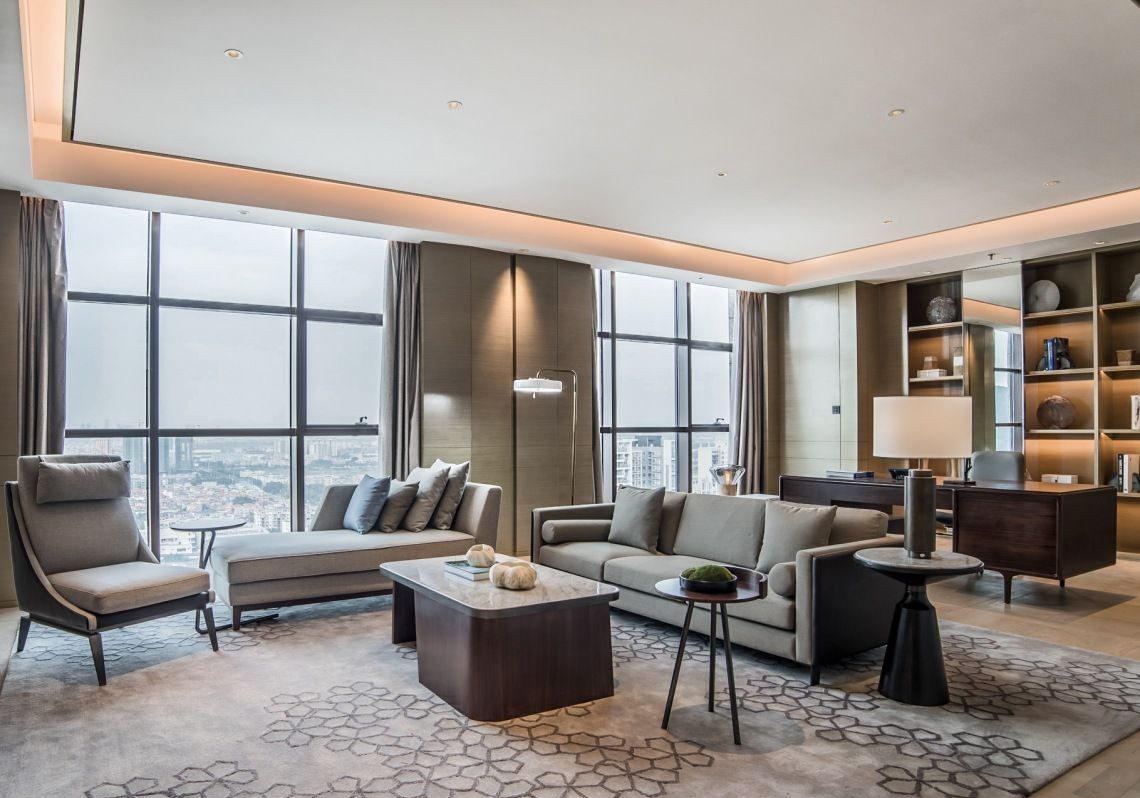
When determining the size of the chairman’s office, the important thing isn’t the number of square meters chosen, but whether that space is compatible with the power structure and how the business operates. First and foremost, the chairman’s office needs to accurately reflect the highest position in the leadership system. In models where the chairman is above the CEO, the size and formality of the office must clearly demonstrate this hierarchy. Having the chairman’s office smaller or less prestigious than the CEO’s office is not only organizationally illogical but can also easily disrupt the perception of power within the organization.
Furthermore, practical functionality is a crucial factor that must be considered. Does the chairman’s office frequently hold meetings? Does it receive high-ranking guests or strategic partners? What level of privacy is required? Each answer will directly determine the size and layout of the space, ensuring dignity, privacy, and effectiveness in each specific situation.
The “correct” area is more important than the “large” area
Furthermore, the size of the chairman’s office must be in harmony with the overall office layout. What percentage of the floor space does it occupy? Does it create a balance with other functional areas? An overly large room in a small overall space will create a disjointed feel, while a room that is too small in a large office will diminish the sense of authority.
From an expert’s perspective, I’ve always maintained that size is merely the foundation. Design is what truly determines class. A well-structured layout, precise furniture proportions, and well-controlled open spaces are the “power spaces” that create value. In reality, a properly designed 40m² executive office always carries far more weight and authority than an 80m² space with a flawed layout.
Conclude
In designing a chairman’s office, the size cannot be chosen based solely on square footage or current trends. Instead, each decision must stem from the chairman’s actual role, the scale of the business, and the intended use of the space. A moderately sized office, around 35–45 m², is usually a safe choice, delivering high efficiency in both functionality and an image of power. Larger spaces should only be considered for clear strategic reasons, such as hosting high-level guests or important meetings. Thus, a smart chairman’s office design is a combination of scale, functionality, and an experience of authority. With our standardized process, Proce will help you create a truly exceptional chairman’s office masterpiece.
>> See more: Schedule a consultation with Proce’s executive office interior design experts.
=====\
PROCE – TOTAL LUXURY OFFICE SOLUTION
Website: https://proce.vn/
Youtube: https://www.youtube.com/@noithatvanphonghangsang
Fanpage: https://www.facebook.com/vanphongnhapkhauProce
GG Business: https://business.google.com/dashboard/l/15115233216900975876
Linkedin: https://www.linkedin.com/company/74359718/admin/
Hotline: 090.115.6767
#thiet_ke_phong_chu_tịch; thiet_ke_phong_chu_tich_chuan_sang;
#thiet_ke_noi_that_phong_chu_tich; #thiet_ke_phong_chu_tich_dang_cap
#noi_that_trong_thiet_ke_phong_chu_tich; Proce_thiet_ke_phong_chu_tich
#thiet_ke_phong_chu_tich_chat