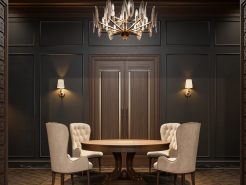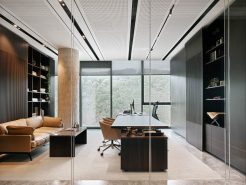

In interior design, the chairman office is always the most carefully considered space. This is because it’s not just a workspace, but also the “face” reflecting the leadership mindset of the entire company. From the perspective of a seasoned designer, I always believe that every detail in this room carries a hidden message. Especially the desk – the central object that influences emotions, behavior, and even how others perceive the status of the person sitting behind it. The large size of the desk doesn’t come from ostentation, but stems from spatial logic, the psychology of power, and the strategic role of the leader. When understood correctly, the desk in the chairman’s office is no longer just a piece of furniture, but becomes a statement about leadership thinking.
Why does the chairman office need a large desk?
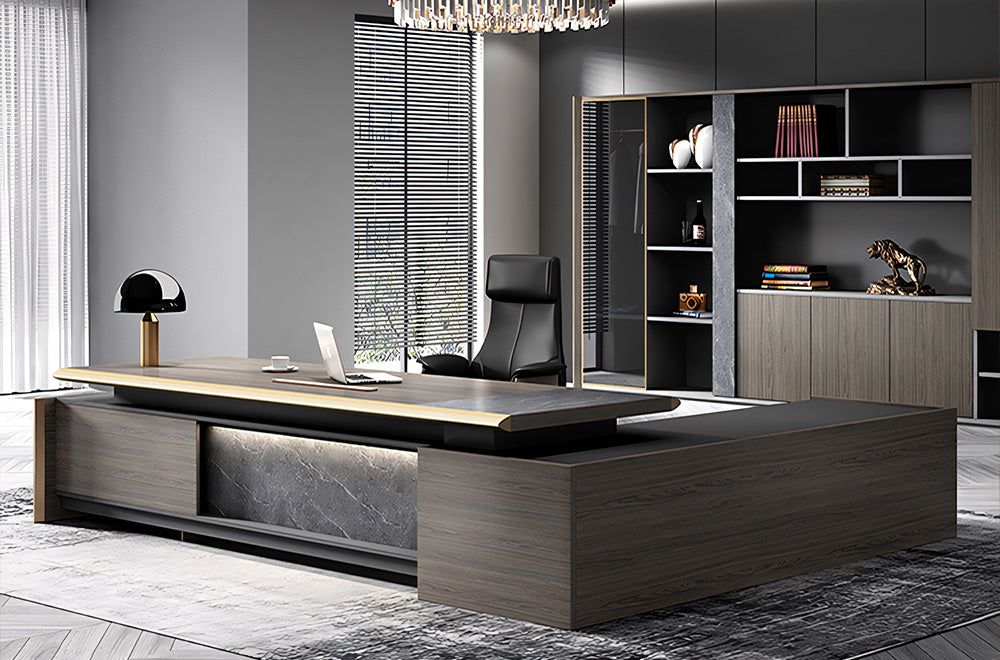
The large desk in the chairman office – The power language of space
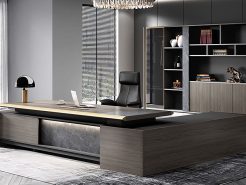
In spatial psychology, people perceive power first through sight, then through words. A large desk thus becomes a silent statement about the status of the person sitting behind it. Upon entering the room, the person facing it unconsciously identifies the center of power through its proportions and size. The larger the desk, the clearer the boundaries, and the more naturally communication order is established. No commands, no rigid attitude are needed. The space itself takes on the role of leader.
The person sitting opposite tends to adjust their behavior, such as maintaining a suitable distance, choosing their words more carefully, and listening more rather than arguing. This is the psychological effect that power design aims for. Importantly, this power doesn’t feel oppressive or ostentatious. On the contrary, it creates stability and order, allowing the exchange to take place within a clear framework. A large desk, when placed in proportion to the room’s space, becomes a silent language of power—more enduring, subtle, and effective than any direct display.
>> See more: Color trends for the president’s office interior in 2026.
In line with the practical functions of the chairman
The essence of a chairman’s job lies not in specific tasks, but in the ability to simultaneously process multiple layers of strategic information. Their desk contains not just files, but the entire picture of the business: finances, human resources, market, long-term plans, and even scenarios yet to unfold. Therefore, a large desk is not a mere formality; it’s a practical necessity – a place where strategic thinking is fully implemented.
A large workspace allows for broader thinking. Placing issues side-by-side allows for the identification of connections, rather than forcing one to think in separate, disconnected pieces. When thinking isn’t limited by space, leaders can more easily maintain a sense of overall control—a key element of top-level decision-making.
Unlike employee desks, which prioritize tidiness and speed of task processing, the chairman’s desk is designed to serve vision and depth of thought, reflecting the highest-level planning and leadership role. There, the space is not just for working, but for thinking, considering, and shaping the future. This is why the chairman’s office needs a large desk; it provides the physical foundation for strategic thinking to operate freely and coherently.
The Chairman Office – A Spacious Space and the Decision-Making Mindset of a Leader
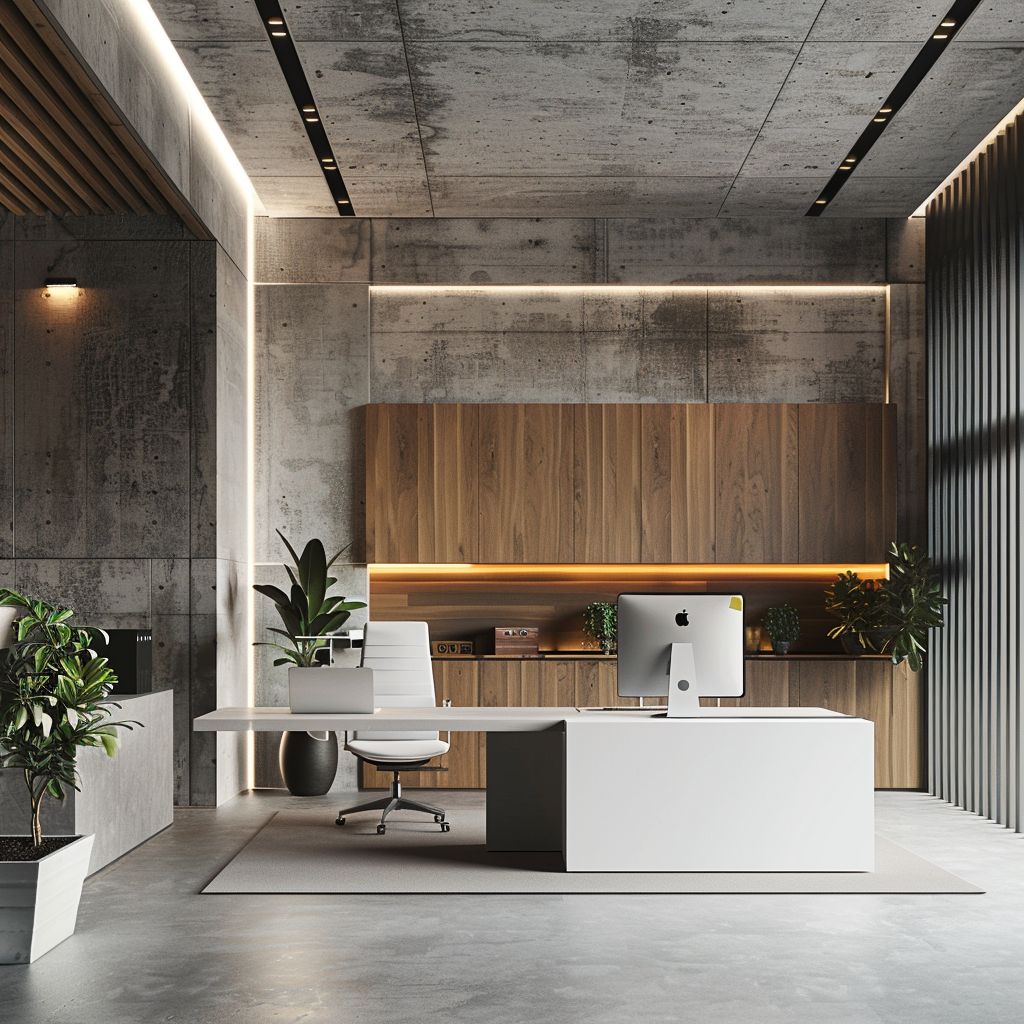
There is an inherent relationship between physical space and the quality of thinking. When space is limited, thinking tends to contract, leading to a feeling of urgency. This results in a tendency to make hasty decisions simply to relieve the invisible pressure from the surrounding environment. Conversely, a sufficiently large space allows thinking to expand, operate more slowly, deeply, and comprehensively over the long term.
A large desk, therefore, is not merely a convenience. Rather, it’s a physical structure that supports the mental state of the leader. When issues are presented broadly, without overlapping or visual clutter, the mind is able to maintain the stability necessary for analysis. In this state, the leader not only sees each issue individually but also recognizes the connections between them, considers multiple parallel scenarios, and overcomes short-term decision-making.
In design, this is known as “space for big thinking.” It’s a place where thinking isn’t constrained by physical limitations. This mental state is crucial for strategic decisions, especially at critical junctures. A sufficiently large desk doesn’t make leaders feel pressured to act, but allows them to maintain the necessary composure to make accurate and insightful decisions.
Symbolic representation of business stability and prestige
The chairman’s office is not just a personal space. It’s also where partners perceive the foundation and aura of the business. From the moment they enter, even before the conversation begins, the space conveys a message of trustworthiness.
A large, sturdy table, placed within a harmonious overall setting, will create a sense of stability and solidity. It shows that the business is built on a long-term foundation, not a patchwork or short-term solution. This is especially true in fields such as finance, real estate, or large-scale manufacturing. A feeling of security is just as valuable as figures or contracts.
A large desk isn’t about extravagance, but about accountability and long-term commitment. Partners, without specific analysis, can sense that they are working with a significant organization—one that is controllable and sustainable enough to partner with. In many cases, this very feeling lays the groundwork for trust, even before the terms are discussed.
>> See more: Feedback from a client regarding the executive office design by Proce.
The depth of feng shui and East Asian culture in the chairman office
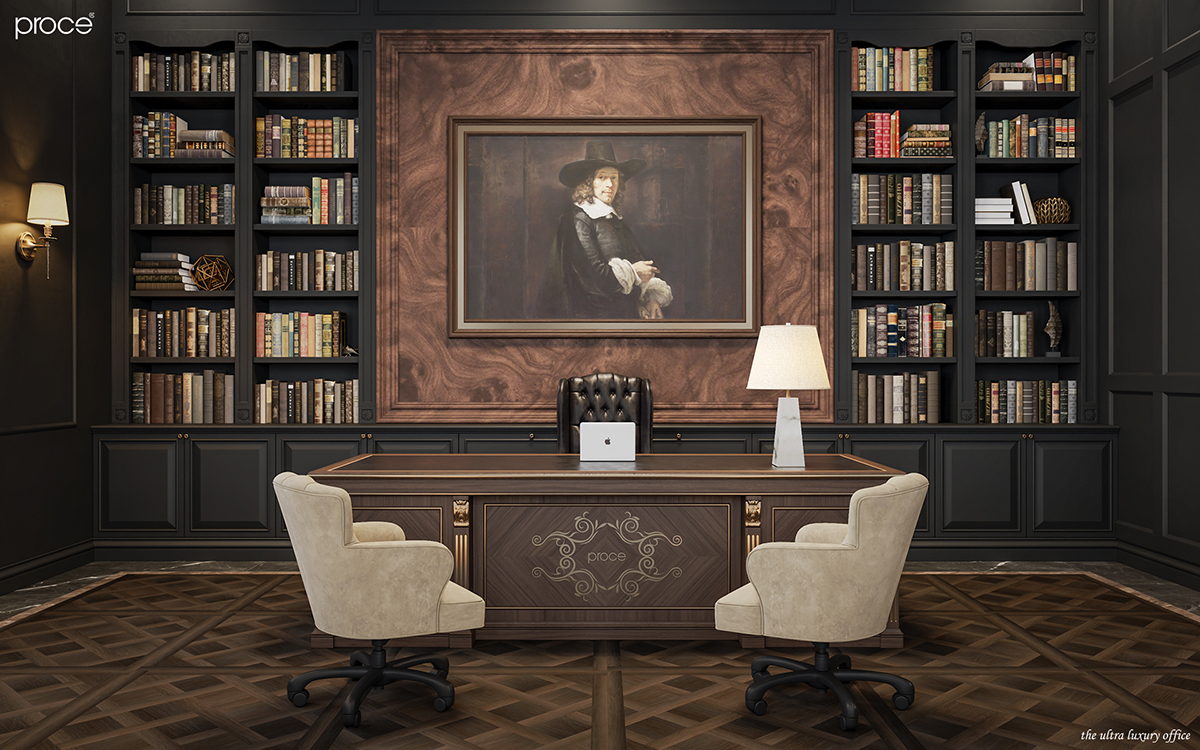
In East Asian thought, the workspace of a leader is always associated with the concept of “position”—a stable position, a position for development, and a position for long-term sustainability. A large desk, therefore, carries a meaning beyond its ordinary function. It symbolizes a strong foundation, a solid root capable of supporting major decisions and a long-term path of development.
When the desk’s orientation is correctly determined, the spatial proportions are balanced, and the materials are appropriately chosen, the overall space will create a sense of stability. It’s a place where the leader clearly feels they are in the right position. This isn’t superstition, but rather a psychological experience formed and accumulated over layers of culture and time.
Therefore, even when pursuing a modern style, many chairpersons still don’t choose small desks. They understand that to lead a large organization, the surrounding space needs to reflect the depth of their thinking and the stability commensurate with their leadership role. In that context, a large desk is not just a piece of furniture, but becomes a symbol of stability, prestige, and a solid, long-term foundation.
>> See more: The reason why the chairman’s office desk uses mortise and tenon joints.
Conclude
The desk in the chairman’s office is not simply a place to put a computer or sign documents. It’s the centerpiece of the entire design philosophy. The desk’s large size accurately reflects the role of the leader: the one who sees the big picture, makes long-term decisions, and bears the highest responsibility. From a design perspective, it’s a tool to support leadership, a psychological symbol of authority, and a strategic element that ensures the space functions correctly. When the design is placed correctly, in the right position, and within the right context, the large desk ceases to be merely ostentatious. It exists as an essential choice, fitting the stature, role, and nature of the chairman office.
=====\
PROCE – TOTAL LUXURY OFFICE SOLUTION
Website: https://proce.vn/
Youtube: https://www.youtube.com/@noithatvanphonghangsang
Fanpage: https://www.facebook.com/vanphongnhapkhauProce
GG Business: https://business.google.com/dashboard/l/15115233216900975876
Linkedin: https://www.linkedin.com/company/74359718/admin/
Hotline: 090.115.6767
#thiet_ke_phong_chu_tịch; thiet_ke_phong_chu_tich_chuan_sang;
#thiet_ke_noi_that_phong_chu_tich; #thiet_ke_phong_chu_tich_dang_cap
#noi_that_trong_thiet_ke_phong_chu_tich; Proce_thiet_ke_phong_chu_tich
#thiet_ke_phong_chu_tich_chat